How do dressage horses travel internationally — and what should you expect?
Buying a horse abroad is a sporting decision followed by a logistics problem. The second one is where deals come apart. Here is how a horse gets from a European stable to a yard on another continent: the paperwork, the timeline, the costs and the part everyone forgets.
The horse is chosen over months. The journey home tends to get decided in an afternoon. Then the sale completes and the questions arrive at once: who books the flight, what is a health certificate, why does the horse need blood drawn weeks before it flies, and what exactly is quarantine.
Transport is not complicated, but it is unforgiving about sequence. Miss a step and the horse does not fly that week — sometimes not that month. Here is how the process is shaped, and where it usually goes wrong.
Road or air — the decision is mostly distance
Within Europe, horses travel by road. A good transporter running a modern lorry covers most country-to-country moves in a day or two, with scheduled rest stops. It is the cheapest option, the one that keeps the horse closest to its normal routine, and the one we use for the majority of sales.
Travelling inside the EU is not paperwork-free. The horse still needs a valid passport with a matching microchip, and the movement is registered with the authorities before it leaves. It is simply routine: your transporter does it, and nothing about it sets your departure date. Everything that follows is about leaving the EU, which is where the timeline stops being yours.
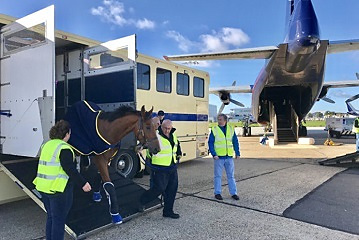
Beyond Europe — the United States, the Middle East, Asia, Australia — horses fly. They travel in a flight stall, a container that holds two or three horses depending on the configuration booked, loaded onto the main deck of a freighter. Horses are accompanied by professional flying grooms throughout.
Air freight is sold by stall share, and the stall is configured for one, two or three horses. Three to a stall is the economy option; two gives more room; a stall to itself is how most high-value horses travel. The price does not scale neatly — a stall to itself costs more than three shared places put together — but for a valuable or anxious horse it is usually money well spent.
Nobody misses a flight because the horse was not ready. They miss it because nobody owned the calendar.
The paperwork, in the order it has to happen
Every destination sets its own import conditions and they change. What follows is the shape of the process rather than a checklist for a specific country — the destination’s current requirements always govern, and a specialist shipping agent is the only reliable source for them.
Identification
The horse needs a valid passport with a correct microchip number and an up-to-date vaccination record. Vaccination records that do not match the destination’s requirements, and a microchip number that does not match the passport, are among the most common last-minute blockers. Check both the week you agree the sale, not the week before departure.
Blood tests
Most non-EU destinations require blood testing for specific diseases, with samples drawn within a defined window before departure and analysed by an approved laboratory. Results take time. This is the step that sets the earliest possible travel date, and it is the one that most often surprises buyers.
Health certification
An official veterinarian issues an export health certificate close to departure, confirming the horse was examined and meets the destination’s conditions. This is a government process, not a private one, and it runs on the authority’s calendar rather than yours.
Pre-export isolation and quarantine
Many destinations require a period of supervised isolation before departure, and quarantine on arrival. Durations vary widely — some destinations ask for a few days, others considerably longer, and requirements can differ for stallions, mares and geldings. Quarantine facilities must be booked; they are not always available on the date you want.
What it costs
We do not publish transport prices, because a figure that is wrong for your route is worse than no figure at all. What we can tell you is what the invoice is made of, so you can read a quotation properly:
- The freight itself — road kilometres, or air based on stall share and route
- Veterinary costs — export examination, blood tests, laboratory fees
- Official certification and customs clearance at both ends
- Quarantine — facility, days, veterinary supervision
- Ground transport at both ends, between stable and airport
- Insurance for the journey
Ask for every line itemised. A quotation given as a single number is not a quotation, it is a figure, and you will not be able to compare it with anything.
What the insurance actually covers
Mortality and transit cover for the journey costs a fraction of the freight bill. We would not move a horse without it. Check what it covers, when cover starts and ends, and whether it continues through quarantine — the gap between “off the plane” and “in your stable” is exactly where people assume they are covered and sometimes are not.
The journey itself, and what it does to a horse
Horses travel better than most people expect. They are loaded into the stall on the ground, the stall is raised to the aircraft, and they spend the flight eating hay. Flying grooms monitor them, offer water regularly and manage any horse that becomes unsettled.
What travel does cost is condition. A long journey is dehydrating, and horses commonly arrive a little tucked up and tired. The first forty-eight hours after arrival matter more than most of the preceding process:
- Water available constantly, and watch that the horse actually drinks
- Walking in hand rather than turnout on day one
- Temperature checked twice daily for several days — shipping fever is the real risk after a long flight, and a rising temperature is a call to the vet that day, not the next morning
- No serious work for two weeks, longer after a long-haul flight and quarantine
That is the routine our partners work to; your own vet sets the final version for your yard and your climate.
Plan the first competition well after arrival. A horse that has flown, stood in quarantine and changed climate, feed and water needs time to come back to itself. Two weeks after landing is too soon, and the entry is rarely worth what it costs the horse.
The timeline, roughly
- At sale agreement — check passport, microchip and vaccinations
- Immediately after — appoint the shipping agent and confirm the destination’s current requirements
- Several weeks before departure — blood samples drawn and sent
- Before departure — pre-export isolation, if the destination requires it
- Days before — official veterinary examination and export certificate
- Departure — ground transport, flight, arrival clearance
- On arrival — quarantine, then the first forty-eight hours at the new yard
The part people forget
Someone has to own the process. Between the seller, the buyer, the shipping agent, two veterinarians, two customs authorities and a quarantine facility, there are eight parties who each assume another one is tracking the dates. That is how horses miss flights.
Whoever that person is — your agent, the shipping company, or you — appoint them explicitly and make sure everyone knows who it is.
How we handle it
We manage transport from stable to stable with partners we have worked with for years. That means we book it, we chase the paperwork, we tell you what is happening at each stage, and we are the single point of contact when something changes. Transport and its costs are quoted clearly and agreed before anything is booked.
If you are buying from Europe and the logistics are the part that worries you, tell us where the horse is going and we will set out the route, the timeline and an itemised estimate, with the lines that can still move marked as such. You can also read about what happens at the vet check that comes before any of this, about how we assess a horse before that, or about the rest of what we handle.