What happens during a pre-purchase veterinary examination — and why it matters
A vet check is the moment a horse purchase becomes real. It is also the moment most buyers discover how little they were told to expect. Here is what actually happens, what the findings mean, and what to decide before the vet ever puts a hand on the horse.
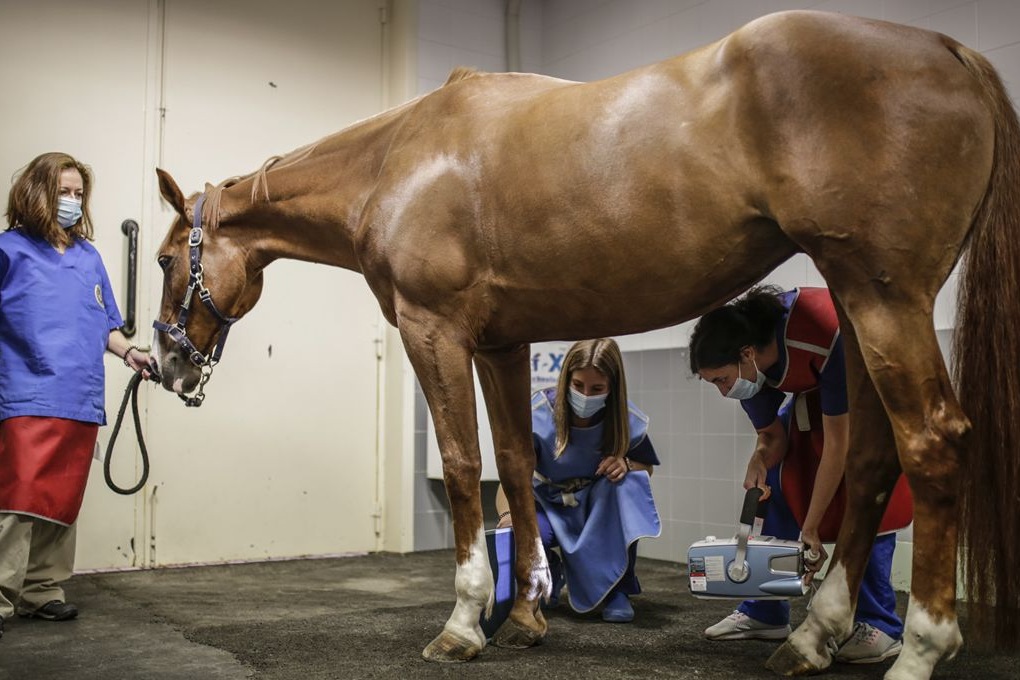
Every serious horse purchase reaches the same point. You have ridden the horse, you like it, the price is agreed in principle — and now a veterinarian is going to spend most of a morning on the horse, and what goes in the report will decide whether the deal survives. It is the part of the process people most often walk into without knowing what the day will actually involve.
This is what a pre-purchase examination involves, what the findings actually tell you, and the decisions you should make before the vet arrives.
What a pre-purchase examination is — and is not
A pre-purchase examination, often shortened to PPE or simply “the vetting”, is a snapshot. A veterinarian examines the horse on a given day and reports what they find. That is the whole job.
It is not a guarantee. It does not predict how long the horse will stay sound, and it cannot tell you that the horse will reach Grand Prix. A clean examination means no significant findings were detected that day — which is valuable, and is not the same as a promise.
Understanding that distinction changes how you read the report. The question is never “did it pass?” The question is “what did we find, and what does it mean for what I intend to do with this horse?” A finding that would end the conversation for an international Grand Prix prospect may be irrelevant for a horse bought to do national small tour for five years.
A clean report is not a promise. It is a photograph taken on a Tuesday.
The clinical examination, step by step
The order varies between vets and between countries, but the components are broadly consistent across Europe.
At rest
The vet starts with the horse standing still: general condition, conformation, eyes, heart and lungs, teeth, skin, and a methodical palpation of the limbs, back and neck. Digital pulses are checked, as is the hoof with hoof testers. This is also when old scars, splints, windgalls and any existing swellings are recorded — not necessarily as problems, but so that everyone knows they were already there.
In movement
The horse is walked and trotted in a straight line on a hard, level surface, then usually lunged on both reins on hard and soft ground. Lungeing on a hard surface is kept brief — it is demanding on the limbs — and it is the most informative minute of the examination: the circle loads the limbs asymmetrically and reveals irregularities a straight line hides.
A good vet will also want to see the horse ridden. Some irregularities only appear under a rider, under contact, or in collected work. If the examination does not include ridden work and the horse is being bought to compete, ask why.
Flexion tests
Each limb is held in a flexed position for a set time, then the horse is trotted off immediately. A positive response — a few short strides that resolve quickly — is common and does not automatically mean disease. A strong, sustained positive response is a different conversation, and usually leads to imaging of that joint.
Flexion tests are the most over-interpreted part of the whole examination. They are a screening tool that tells the vet where to look next.
Radiographs: how many, and which ones
In the Dutch and German markets, radiographs are a normal part of a sport-horse examination rather than an optional extra. A standard set for a dressage horse covers the front feet and fetlocks, the hind fetlocks, hocks and stifles. Neck and back are increasingly requested in dressage, but they are an extension of the protocol rather than part of it: they add views, cost and time, and they have to be agreed in advance.
Two practical points that buyers rarely hear in advance:
- More images means more findings. Radiograph a large enough number of healthy competition horses and you will find something on most of them. The skill is in interpretation, not in collecting pictures.
- Agree the protocol before the day. Which views, which extra regions, and who decides if the vet wants to add more. Discovering mid-examination that the back was not included — and that adding it costs more and extends the day — is avoidable.
A blood sample is usually drawn and held. It can be analysed if the horse’s behaviour or movement later raises a question about medication at the time of the examination. Make sure it is taken.
What findings actually mean
Reports rarely come back empty, and they are rarely binary. Most findings sit in a middle zone that requires judgement:
A small fragment in a fetlock, mild changes in the hocks, changes in the neck — findings of this kind mean different things on different horses, and only your veterinarian, with the clinical examination in front of them, can tell you which. What we can say is that a clean sheet is rare, and that a finding is the beginning of a conversation rather than the end of one.
What matters is the combination: does the imaging explain something the clinical examination also showed? A finding that lines up with a flexion response and a history of intermittent lameness is a different proposition from the same finding on a horse that moves evenly and has never missed a day.
If the report is ambiguous — and good reports often are — the honest answer is to pay for a second opinion from a specialist in that region. Against the price of the horse, it costs nothing.
Who chooses the vet, who pays, and who owns the report
The buyer pays for the pre-purchase examination and the buyer chooses the veterinarian. That is the standard, and it should be non-negotiable. A vet appointed and paid by the seller is working for the seller, however honest they are.
Use a clinic with no commercial relationship to the yard selling the horse. If the seller insists on a particular vet, that in itself is information.
In practice the report goes to whoever commissioned it, and sharing the radiographs with a seller is courtesy rather than obligation. Agree in writing with the clinic, before the day, who gets the images — the rules on diagnostic images are not the same in every country — and if the sum involved justifies it, ask your lawyer.
Before the vet arrives, agree these five things in writing
- Which clinic and which veterinarian
- The exact radiograph protocol, and who authorises extra views
- Whether ridden work is included
- That a blood sample will be taken and stored
- What happens to the deposit if the findings end the sale
The questions worth asking the vet
When the examination is done, resist the urge to ask “would you buy it?” — most vets will decline, and correctly so. Ask instead:
- What did you find, and which findings would you want to re-check in twelve months?
- Does anything here limit the work this horse can do?
- If this horse were going to be sold on in three years, which finding would a future buyer question?
That last question is the useful one. It separates findings that matter clinically from findings that matter commercially — and for a horse you may sell again, both are real.
How we handle it
We organise the examination and give you commercial context. The clinical interpretation is your veterinarian’s, always.
Commercial context means this: whether the price still makes sense given what the report says, what a future buyer is likely to question in three years, and whether a finding is worth a second opinion before you decide. If we think a horse should not be bought, we say so, even when the sale is already in motion.
If you are at this stage with a horse — ours or anyone else’s — you can get in touch. You can also read about how we assess a horse before it reaches this point, about what transport involves once it does, or about the rest of what we handle.